
Chesapeake Directory Holdings by Period
Chesapeake does not have a verified, continuous city-only directory run listed online. The useful shelf is regional and fragmented. A researcher may need Norfolk County, South Norfolk, Norfolk, Portsmouth, or a community name before finding a household that later falls within Chesapeake. The named collections are verified starting points. A title in a catalog is a discovery lead, not proof that every modern neighborhood appears in every volume.
| Collection | Verified period | Keeper or location | How to use it |
|---|---|---|---|
| Hill Norfolk and Portsmouth directory | 1921 | FamilySearch Library Books viewer | Online page images; inspect alphabetical and street/house sections |
| Regional Norfolk, Portsmouth, Chesapeake and Virginia Beach telephone directory | 1964 | Library of Congress directory discovery trail | Confirm a local scan or holding before relying on it |
| U.S. City Directories collection | 1861–1960 collection-wide | Library of Congress guide and map | Local coverage varies by community and volume |
| Wallace Room local-history materials | Varied; exact runs unpublished | Chesapeake Central Library | Request a shelf check for paper, telephone, or criss-cross volumes |
| Norfolk County and South Norfolk microfilm | Historic series from 1637 onward | Library of Virginia VA195 catalog | Bridge gaps with land, plat, probate, tax, and court names |
The Library of Congress city and telephone directory guide describes irregular publication and volumes arranged by surname, street, address, or phone number. Search the catalog by the historic jurisdiction rather than assuming a modern Chesapeake heading. The 1964 regional telephone book is a subscriber source, so its absence does not rule out a household.
Wallace Room Directory Shelf
The Wallace Memorial History Room is the physical starting point when a web catalog does not name a needed volume. It is on the second floor of Chesapeake Central Library, 298 Cedar Road, and serves as the Norfolk County Historical Society headquarters. Its historical and genealogical material covers Chesapeake, the predecessor Norfolk County and South Norfolk, plus the surrounding Southeast Virginia and Northeast North Carolina region. The collection does not circulate, so ask the Reference Desk for the room and a place to work with the material.
The Society lists Monday through Thursday hours of 10 a.m. to 8 p.m., Friday 10 a.m. to 6 p.m., Saturday 10 a.m. to 5 p.m., and Sunday 1 p.m. to 5 p.m. The room can be locked when a volunteer is unavailable. Call 757-382-8408 or email nchs.wallaceroom@gmail.com before a special trip, and ask staff to verify a year or format that is not listed online.
See the Norfolk County Historical Society’s Wallace Room information before visiting.
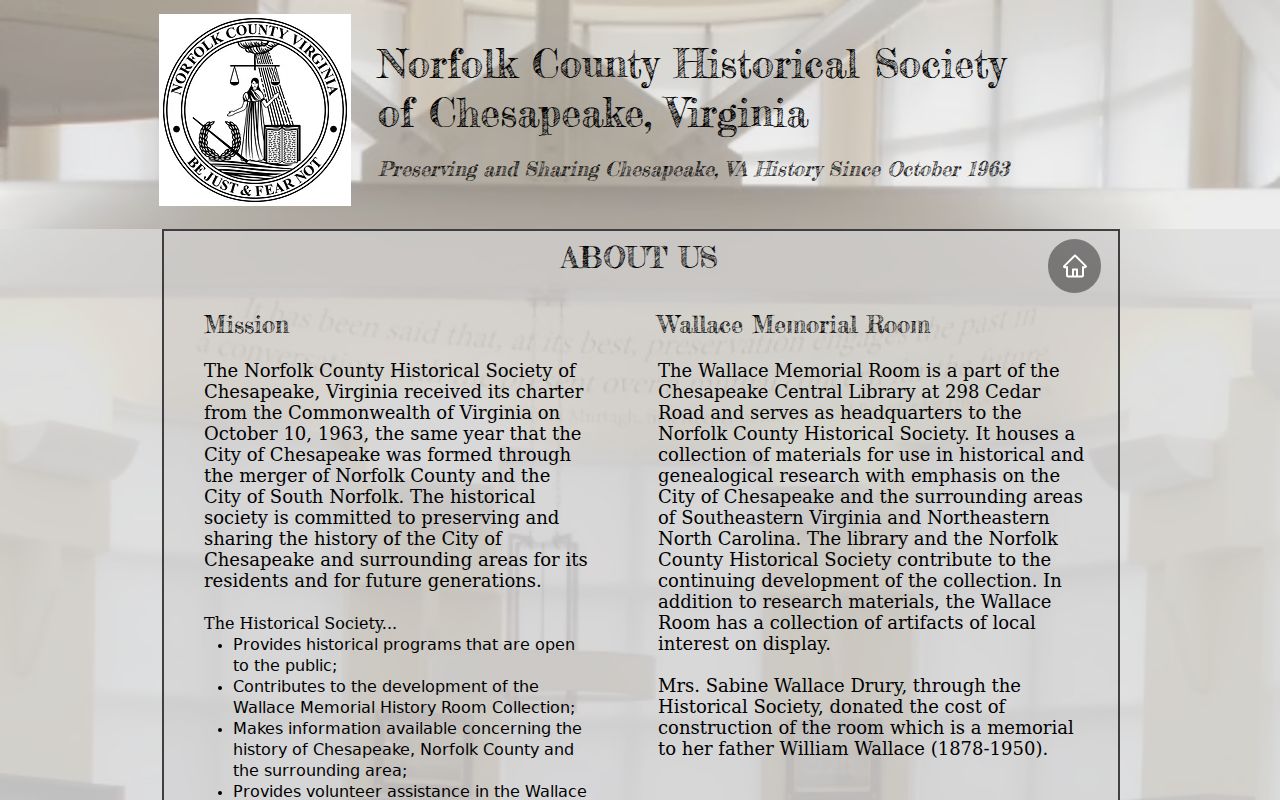
The Wallace Room is a reading-room fallback for bound directories, clippings, local books, maps, and finding aids that may not appear in an ordinary library search.
1921 Chesapeake Directory Lead
The 1921 Norfolk and Portsmouth, Virginia, directory was published by Hill Directory Company. Its catalog record includes Chesapeake as a subject even though the present city had not yet formed. That makes it a useful Norfolk County and South Norfolk context source, not a promise of coverage for each present-day community. The digitized volume has 1,469 pages and was digitized from the Houston Public Library collection.
Open the 1921 Hill Directory Company volume in the FamilySearch viewer to work from page images rather than a search-engine snippet.
Record the page number, printed jurisdiction, spelling, and address exactly as shown. That careful note helps distinguish a later Chesapeake interpretation from the wording used in the original volume.
Regional Phone Books After Formation
A 1964 Norfolk, Portsmouth, Chesapeake, and Virginia Beach telephone directory is verified through the Library of Congress and Virginia directory discovery trail. It is the early post-formation regional volume where Chesapeake is named as a city. The catalog snippet does not separately identify the publisher, and a local scan still needs confirmation. Treat it as a targeted lead for a subscriber name, address, or telephone listing.
Telephone directories have a different limit than an alphabetical household directory. They reflect subscribers. A person may be absent because service was in another name, unlisted, or not held at the address. Compare a telephone entry with a deed, an obituary, a newspaper notice, or a census record before drawing a family conclusion.
Chesapeake Records Timeline
The date on a volume has to be read with the date of the jurisdiction. Chesapeake is a modern city name for a much older landscape. The verified printed leads sit on both sides of consolidation, while the Library of Congress collection guide gives a broader, irregular directory range. This short timeline helps choose the first catalog label and the next companion source.
- 1861–1960: the U.S. City Directories collection is organized across many localities and publishers; Chesapeake-area coverage must be checked volume by volume.
- 1921: Hill Directory Company published the Norfolk and Portsmouth volume that carries Chesapeake as a subject and can lead to Norfolk County or South Norfolk context.
- 1963: Norfolk County and South Norfolk consolidated into Chesapeake, changing the jurisdiction label that later searches use.
- 1964: the verified regional telephone directory names Chesapeake alongside Norfolk, Portsmouth, and Virginia Beach.
There is no verified first or last Chesapeake-only directory year in the research. A shelf check at the Wallace Room and a catalog search under predecessor names remain better evidence than filling a gap with an assumed run.
Decode a Chesapeake Directory Entry
A directory entry is a compact transcription problem. First capture the name as printed, then the address and every notation beside it. The exact abbreviation key belongs to the chosen book, usually in introductory pages, so do not assume that a mark means the same thing in each publisher’s volume. A record may include a spouse or household designation, an occupation or business role, a street address, a phone number, a widow or marital-status notation, and cross-references.
| Printed name | Surname, given name, initials, and any spelling variation used by the volume |
|---|---|
| Household wording | Spouse, widow, or other household designation where the directory supplies one |
| Occupation or business | Work or business description, and an employer or business name when printed |
| Street line | House number, street, phone, and any h/r-style notation exactly as shown |
| Cross-reference | Business classification, page reference, or street-and-house section when provided |
- Criss-cross directory
- An address-first section that lists a street and house number before the listed name or subscriber.
- Householder index
- A name or address arrangement intended to locate the household line, not a complete count of all people at an address.
- Abbreviation key
- The publisher’s own explanation of initials and marks. Photograph or note it before interpreting an entry.
Transcribe rather than expand the entry. A copied address, notation, and page citation can be checked later against the book, while an added assumption about a relationship, residence, or date cannot be supported by the printed line alone.
Street Sections in Chesapeake Directories
For an address-first question, locate the street alphabetically and then the house number. Depending on the book, the section may be called a street and avenue guide, house directory, numerical street directory, directory of householders, or criss-cross section. Copy every listed person, business, telephone number, and notation. That evidence can expose a misspelled surname or a name indexed under a different given name.
The historical street section is the proper place to test an old address. Modern parcel and ownership work belongs with the Chesapeake street directory record trail, which uses current property tools instead of rebuilding the historical shelf. Keep the volume title and page with each result, because an address may be described differently across decades.
Predecessor Names in Chesapeake Directories
Chesapeake began through the 1963 consolidation of Norfolk County and South Norfolk. A pre-1963 entry may therefore be filed under Norfolk County, South Norfolk, Norfolk, Portsmouth, Berkley, or a named community. South Norfolk’s dense streetcar-suburb grid grew in the 1890s through the 1930s, while other parts of the present city followed older rural roads and community names. The record label is part of the evidence.
The Library of Virginia’s VA195 microfilm catalog offers the other half of that story. It identifies Norfolk County deed-index series, grantor and grantee indexes, map indexes, and early Chesapeake index material. When a printed source goes quiet, the chain does not necessarily end. It may have moved to a predecessor book, a map index, or a different custodian.
Trace Chesapeake Directories With Census
Use one year at a time. A directory can place a name near a street address between censuses, while an individual census schedule can show the household at its enumeration date. Federal individual schedules through 1950 were the latest public release at the research cutoff. Later individual schedules are not public. Neither source should be treated as a current list of residents.
- Find the earliest plausible name or address entry and note the title, year, page, and spelling.
- Follow the name forward through available volumes, recording each address, phone, occupation, and notation change.
- Check the street-and-house section for the listed address and nearby entries in that same volume.
- Pair the directory years with the relevant released federal census schedule to compare household context.
- Use a probate record, cemetery lead, or obituary only as a dated endpoint, then verify it with the appropriate primary record.
Keep an evidence ledger with year, title, publisher, page, printed address, name spelling, household wording, occupation, phone, notation, and image location. A disappearance can mean a move, a death, an unlisted phone, a publisher change, or a missed transcription. It does not settle the reason by itself.
Newspapers Beside Chesapeake Directories
Chesapeake Public Library offers America’s Newspapers remotely with a library card and PIN, while Ancestry historical records are available in the library only. Search a surname with Norfolk County, South Norfolk, Great Bridge, Deep Creek, Western Branch, Hickory, Indian River, Portlock, or another community name. The local label can matter as much as the surname.
Newspaper notices can supply a move date, marriage announcement, obituary, property notice, organization event, or business advertisement. Virginia Chronicle and Chronicling America add free title-specific searching. These are useful companions to a directory line, but a deed, probate file, vital record, or original directory page remains the stronger source for the fact it records.